DUCK FEET
How to fix duck feet: point them straight, wake the arch.
Duck feet means the feet turn out when you stand, walk or run. Shoes, sitting and old injuries often drive it, and it leaks power: each push goes partly sideways instead of straight back. Fix it feet first. Point the feet straight, press the big toe down, lift the arch and keep each knee over the second toe.
By Muhammed Cam, founder · Updated
Where it starts · Shoes
Shoes turned your feet out.
This is the first leak. Narrow, cushioned shoes push the big toe in and let the arch drop, and the feet turn out to find balance. On the right, the inner ankles roll in and the big toes angle in toward the second toe.
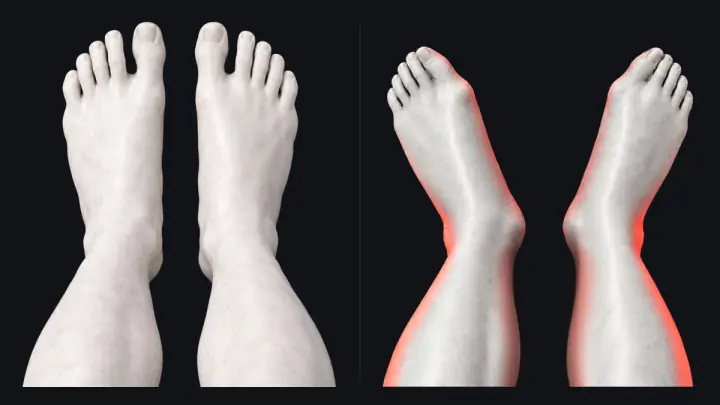
- Working
- Problem: tight or weak
The fix: Feet forward. Point them straight. Wake the arch.
What causes duck feet?
In my experience, shoes start it. A narrow toe box pushes the big toe in toward the other toes, the arch loses its anchor and drops, and the feet turn out to find a stable base. Sitting adds to it, with the hips spending hours rotated out. Old ankle, knee or hip injuries can lock it in, because the body adapts around them.
Some people are built with a little turn-out in the hip or shin bones. That part won't change, and it doesn't need to. The question is how much of yours is habit and how much is structure. Most people find there's more habit in it than they expected.
Why does it matter if my feet turn out?
Because the push leaks. When the foot points out, part of every push goes sideways instead of straight back. Over thousands of steps that's lost speed and extra work for the knees and hips.
It also moves the knee off its line. With the feet out, the knee points out as the leg swings, then caves in over the dropped arch when you land. Either way it's off the second toe, which is why duck feet and knees caving in travel together. The arch usually follows too: turned-out feet and flat feet are often the same pattern.
You can often see it in the calves. With the feet turned out, the outer calf does most of the work and the inner calf stays small. Mine only started to fill out once my big toe began pressing down properly.
How do I fix duck feet?
Build it a little every day, rather than forcing the feet straight all at once:
- Stand with the outside edges of the feet parallel, hip-width apart.
- Press the big toe down without curling it, and lift the arch.
- Keep each knee over the second toe. Not in, not out.
- Walk short stretches like that, pushing off the big toe, and build the distance week by week.
- Stretch what pulls: the outer hips and calves, with the feet straight.
- Give the toes room: a wide toe box, barefoot time at home, toe spacers.
The foot strengthening exercises guide has the drills that make the new position hold.
How long does it take to fix duck feet?
Months, not weeks. For my whole body it took two to three years, and every time I thought I was there, a plateau showed me how much further there was to go.
Expect the ache to move. As my feet turned in from duck-footed, the pressure shifted to my inner knees and they ached until the inner thighs got strong enough to take the load. Soreness in a new place often means the chain is waking up. Sharp joint pain means stop and get it checked.
A 60-second self-test
Feel it now
- 1Stand barefoot, feet hip-width apart, both pointing straight ahead.
- 2Press the big toe down without curling it, and lift the arch.
- 3Soften the knees and keep each one over the second toe.
- 4Close your eyes and hold it for 30 seconds.
What pulls is tight. Stretch it.
What shakes or can’t hold is weak. Strengthen it.
On this page, notice
- As the feet point straight, feel what pulls: the outer hips, the outer calves, the inside of the knees?
- Which knee wants to drift in or out when you close your eyes?

The app · coming soon
Not sure which leak is yours?
The From the Feet Up app is a posture and movement scan for iPhone. Six photos, bare feet, about three minutes. It reads five areas from the feet up and tells you what to fix first. Free for now.
Your photos are sent once for the read, never kept on our servers, and saved only on your phone.
Hear first when it launches.

Common questions
Is it bad to walk with your feet turned out?
A slight turn-out is normal for many people. A lot of turn-out can leak power and change how the knees and hips load. It isn't an emergency, but it's worth working on if you play sport or have aches that keep coming back.
Can duck feet be corrected in adults?
The habit part often can, with daily work on foot position, the big toe, the arch and the hips. Any turn-out that comes from bone shape won't change, and doesn't need to.
Do duck feet cause knee pain?
They can contribute. Turned-out feet move the knee off the second toe, so it twists as it bends. Not every sore knee comes from the feet, but they're worth checking first.
Should I force my feet straight when I walk?
Not all at once. Forcing the feet straight without the strength to hold them can just move the strain. Build it in short stretches and let the hips, arches and calves catch up.
Are duck feet genetic?
Partly, for some people. The shape of the hip and shin bones can add some turn-out. In my experience, most of it comes from shoes, sitting and old injuries, which is the part you can change.
Educational, not a diagnosis or treatment plan. Sharp, severe, numb or worsening pain needs a qualified professional.